
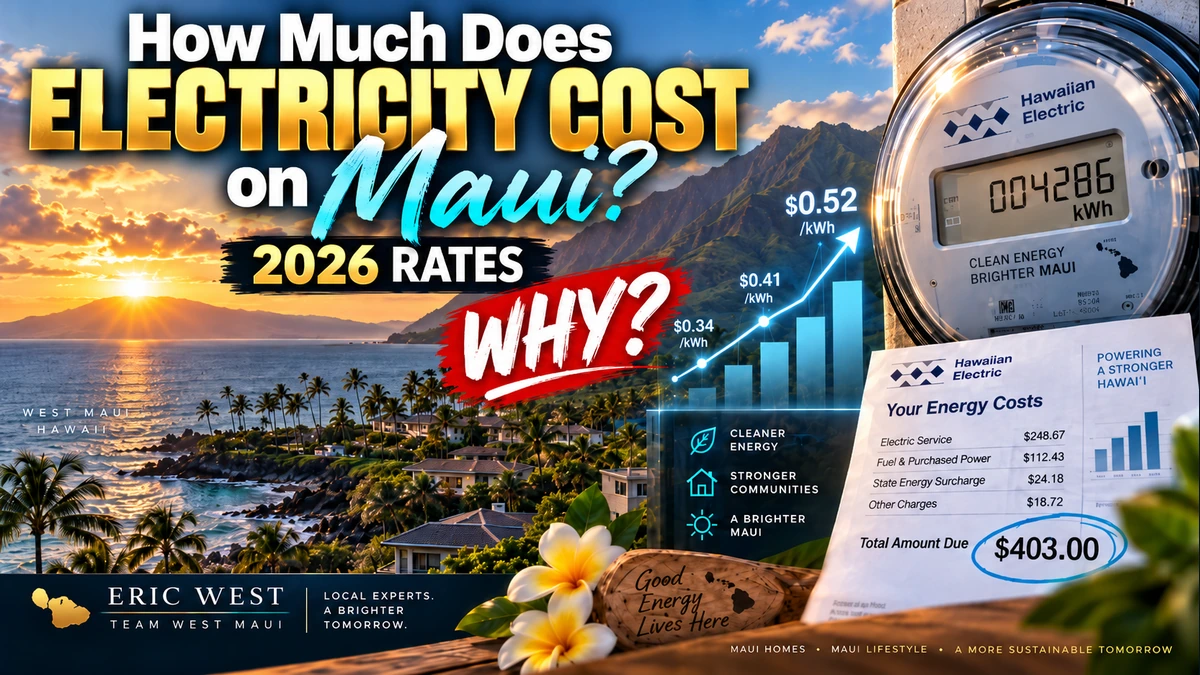
How much is electricity on Maui? Hawaiian Electric's July 2026 rate filing puts a typical Maui home using 500 kilowatt-hours (kWh) at $244.23 for the month, which works out to about 48.8 cents per kWh all in. The U.S. residential average that same month was 18.31 cents, so this Maui billing example works out to roughly 2.7 times the national realized average. These are different measurement methods, not identical tariff comparisons. For the full year 2025, Maui residential customers averaged 41.58 cents per kWh.
Watch: How Much Is Electricity on Maui?
In the video I walk through the same numbers on screen: the price history since 2011, a side by side Maui versus mainland comparison, and what 1,000 kWh would cost here versus the U.S. average. If you're budgeting for a Maui home, it's a fast way to see why the electric bill deserves a line in your spreadsheet.
Why the video uses a different number: EIA Form 861-M reports a 52.76¢/kWh residential realized average for Maui Electric in July 2026, calculated from total residential revenue divided by electricity sold. That is about 2.9 times the U.S. average. The EIA utility record includes Maui Electric's service on Maui, Molokaʻi and Lānaʻi; the 48.846¢ figure above is the all-in effective cost of Hawaiian Electric's specific 500-kWh Maui-island bill example. The video and this article use both measures with their geographic scope and calculation clearly identified.
A kWh is one kilowatt of power used for one hour, roughly what a window AC unit burns in an hour or two. Below you'll find what that means for a real monthly bill, how Maui compares with the mainland, why prices swing so much, and what I tell buyers to check before they make an offer.
How Much Does Electricity Cost on Maui in 2026?
Quick answer: Maui residential electricity prices vary by month, rate schedule, usage and measurement method. Hawaiian Electric's July 2026 filing implies about 48.8 cents per kWh for a 500 kWh home. Hawaii's statewide July 2026 average was 48.00 cents, the highest in the country.
| Measure | Period | Price | Source |
|---|---|---|---|
| Maui island annual residential average (Schedule R) | 2025 | 41.58¢/kWh | Hawaiian Electric |
| Typical Maui bill at 500 kWh | July 2026 rates | $244.23 (about 48.8¢/kWh) | Maui Electric filing to the PUC |
| Hawaii statewide residential average | July 2026 | 48.00¢/kWh | EIA Electric Power Monthly, Table 5.6.A |
| U.S. residential average | July 2026 | 18.31¢/kWh | EIA Electric Power Monthly, Table 5.6.A |
Why Maui rates move every month
Your Maui bill isn't one flat price. The base rate is set by the Hawaii Public Utilities Commission, but stacked on top is an Energy Cost Recovery factor that Maui Electric resets every month to pass through what it actually paid for fuel and purchased power. When oil jumps, your bill follows a month or two later. In July 2026 that one line was 27.998 cents per kWh by itself, down 2.59 cents from June. A year earlier, the same 500 kWh Maui bill was $206.68. That's an 18% increase in twelve months with no change in how much power the house used.
Price per kWh versus your actual bill
Two homes on the same rate can have wildly different bills. The price per kWh tells you what each unit costs. Your actual tariff bill depends on the energy charges for your usage, any applicable usage tiers or time-of-use periods, and customer charges and surcharges. An all-in average already reflects billed charges, so do not add those fixed charges a second time when using it for an illustrative estimate. A Kīhei condo running a mini-split in the bedroom and a 3,500 square foot Wailea home cooling every room are paying the same rate. Their bills just aren't in the same universe.
What Is the Average Monthly Electric Bill on Maui?
The best measured number I've found comes from the state's utility reports. In September 2025, Maui island residential customers used about 521 kWh on average and paid about $209, based on DBEDT's historical monthly energy workbook (Maui sheet, September 2025: 30,129,845 kWh and $12,114,295 in residential revenue divided by 57,833 residential accounts). It is a utility-account average across different home sizes and solar arrangements, not a forecast for a particular property.
Here's what different usage levels would cost. These are illustrative calculations, not quotes.
| Monthly use | At 2025 annual average (41.58¢) | At July 2026 typical-bill rate (about 48.85¢) |
|---|---|---|
| 500 kWh | $207.90 | $244.23 |
| 750 kWh | $311.85 | $366.35 |
| 1,000 kWh | $415.80 | $488.46 |
| 1,500 kWh | $623.70 | $732.69 |
| 2,000 kWh | $831.60 | $976.92 |
The 48.85¢ column divides Hawaiian Electric's July 2026 500 kWh bill ($244.23) by 500. It includes fixed charges for that example. Multiplying it at other usage levels does not reproduce the actual tariff: fixed charges, increasing usage tiers and time-of-use schedules can change the result. Treat the larger rows as ballpark equivalents, not utility bill quotes.
Don't read the 1,000 kWh row as typical. The average Maui account uses about half that. Where you land depends mostly on air conditioning, house size, a pool pump, an electric vehicle, and whether there's solar on the roof.
Maui Electricity Prices vs. the Mainland
The figures below use July 2026 residential electricity data. The Maui-island row is an illustrative bill-derived effective cost; state and U.S. rows are EIA realized averages, so the methods differ.
| Location | July 2026 | Times the U.S. average |
|---|---|---|
| Maui (typical 500 kWh bill rate, Hawaiian Electric) | 48.85¢ | 2.7x |
| Hawaii statewide | 48.00¢ | 2.6x |
| California | 33.61¢ | 1.8x |
| Colorado | 17.00¢ | 0.9x |
| Texas | 15.88¢ | 0.9x |
| U.S. average | 18.31¢ | 1.0x |
State and U.S. figures: EIA Electric Power Monthly, Table 5.6.A (preliminary July 2026 data, released September 24, 2026). The Maui row comes from a utility rate filing, a slightly different method than EIA's revenue-divided-by-sales average.
If you're moving from Denver or Dallas, expect to pay close to three times as much for every kWh. Even Californians, who are used to high power bills, should budget for about 45% more per kWh than their state average.
How Have Maui Electricity Prices Changed Over Time?
Prices have been anything but steady. They fell hard when oil collapsed in 2015, bottomed out in 2016, then jumped sharply in 2022 after oil spiked and stayed near that higher level.
| Year | Average | Geography |
|---|---|---|
| 2014 | 38.23 | Maui County |
| 2015 | 31.35 | Maui County |
| 2016 | 28.70 | Maui County |
| 2017 | 30.89 | Maui County |
| 2018 | 34.21 | Maui County |
| 2019 | 34.01 | Maui County |
| 2020 | 33.45 | Maui County |
| 2021 | 35.12 | Maui County |
| 2022 | 43.80 | Maui County |
| 2023 | 43.77 (Maui island only: 43.31) | Maui County |
| 2024 | 43.59 | Maui island |
| 2025 | 41.58 | Maui island |
2014 to 2023: DBEDT, Electricity Burdens on Hawai'i Households (Jan 2025), Table A-1, which covers Maui, Moloka'i and Lāna'i combined. 2023 island figure and 2024–2025: Hawaiian Electric's Maui-island annual average-rate workbook. The county and island figures cover different geographic areas and should not be read as a single like-for-like series. Annual averages smooth out monthly spikes; the 2026 monthly readings above are a different measure.
From the 2016 low to the 2022 high, the average rose about 53%. And 2026 has pushed higher again: the typical 500 kWh bill went from $202.97 in January 2026 to $244.23 by July.
Why Is Electricity So Expensive on Maui?
Imported fuel. Maui still burns a lot of oil to make electricity, and every barrel arrives by ship. When global oil prices rise, the monthly fuel factor on your bill rises with them.
An isolated island grid. Maui can't borrow power from a neighbor when a plant trips. Hawaiian Electric points out it has no nearby utilities to draw from, so it has to keep reserve generating capacity and multiple delivery routes on hand. That backup costs money whether it runs or not.
Generation and distribution on a small scale. Plants, substations and lines get spread across far fewer customers than on a mainland grid, so each household carries a bigger share.
Infrastructure and reliability. Poles, lines, substations, wildfire safety work and storm hardening all cost money, and the costs the PUC approves end up in rates.
Renewable transition. Hawaii's law requires 100% renewable electricity by 2045. Solar, wind and batteries reduce exposure to oil over time, but the transition takes years of investment, and oil still sets much of the price in the meantime.
Does Solar Power Make Sense on Maui?
When grid power costs 45 to 50 cents per kWh, every kWh your roof makes and your house uses directly is worth a lot. That's why you see panels on so many roofs from Kahului to Kīhei. The math has changed, though, so get specifics before you assume big savings.
- Export rules changed. Hawaiian Electric's older export programs closed to new customers on March 29, 2024. New systems go through the Smart DER program (export or non-export tracks), which began April 1, 2024. Export credits are generally worth less than the retail rate you pay.
- Batteries matter more now. Panels produce midday, but most homes use the most power in the evening. A battery shifts that solar into the 5 p.m. to 9 p.m. peak. Hawaiian Electric's BYOD Plus battery program launched May 15, 2025.
- Payback depends on you. Roof orientation, shade, how much you use during the day, system price, financing and current tax rules all move the number. I won't give you a payback period because nobody can honestly give one without your bills and a quote.
Before you sign anything, confirm the current program terms on Hawaiian Electric's Customer Choice page and talk with a tax professional about credits.
What Should Maui Homebuyers Know About Electricity Costs?
This is where I see buyers get surprised. A $400 electric bill shows up in month one, and nobody mentioned it during escrow. Here's what I ask for on every purchase.
- Twelve months of electric bills. Summer and winter can differ a lot, especially on the dry, sunny side of the island. One month tells you almost nothing.
- The cooling setup. Central air cooling a whole house costs far more than ductless mini-splits you run room by room. Ask the age and efficiency of the units, too.
- Who owns the solar. Owned panels transfer with the house. A lease or power purchase agreement has to be assumed by you, with its own payment and credit approval. Get the contract early.
- Which solar program the system is on. Customers on CGS, CGS Plus and Smart Export must transition to Smart DER Export after seven years, with a six-month grace period. NEM and NEM Plus are exempt from this required transition. Ask the seller for the interconnection agreement and verify current program transition rules.
- Battery or no battery. A working battery changes evening bills and gives you backup during outages.
- Condo utility setup. Some Maui condos bill electricity per unit; in others it's partly inside the maintenance fee, or the building has central chilled water. Read the budget and ask the AOAO.
- Older homes. Single wall construction, no insulation and old windows let heat in. Fine in Kula, harder in Kīhei in September.
- EV charging. Charging at home adds real kWh every month. Factor it in if you drive electric.
Within the same Maui rate schedule and billing period, neighborhood alone does not set the tariff. Your schedule, usage tiers, time of use and solar agreement can still affect what you pay. Kīhei and Wailea run hot and dry, and many homes there lean on AC much of the year. Up in Kapalua, the trade winds and passing showers keep plenty of homes comfortable with ceiling fans and open lanai doors. Kāʻanapali condos vary building to building, so the bill history matters more than the address. In Lahaina, homes rebuilt after the fire are going up under current energy codes, which can help.
Frequently Asked Questions About Maui Electricity
How much is one kilowatt-hour on Maui?
For a typical home on Hawaiian Electric's July 2026 rates, about 48.8 cents per kWh, based on the utility's $244.23 bill for 500 kWh. The 2025 annual Maui island average was 41.58 cents. The exact figure changes monthly because of the fuel adjustment.
What is the average electric bill on Maui?
State data for September 2025 shows the average Maui island residential account used about 521 kWh and paid about $209. Bills have risen in 2026, and that utility-account average covers different home sizes and solar arrangements; a larger house with substantial AC use may pay more.
Is Maui electricity more expensive than California?
Yes. In July 2026, California's average residential price was 33.61 cents per kWh. Hawaii's statewide average was 48.00 cents, and a typical Maui bill worked out to about 48.8 cents. That's roughly 45% more per kWh than California.
Why is Hawaii electricity so expensive?
Most islands still rely heavily on imported oil, each island runs its own grid with no connection to a neighbor, and utilities must carry backup capacity for reliability. Those costs get spread over a small number of customers, and fuel price swings pass straight through to monthly bills.
How much does it cost to run air conditioning on Maui?
It depends on the system. As an illustration, a central unit drawing about 3 kW for 8 hours a day uses around 720 kWh a month, close to $350 at July 2026 rates. A single 1 kW mini-split running 8 hours a day is about 240 kWh, near $117. Your equipment and habits will change these numbers.
Is electricity cheaper if you have solar?
Usually your bill is lower, because every kWh your panels produce and you use yourself avoids the grid rate. Savings depend on system size, daytime use, whether you have a battery, and your Hawaiian Electric program. New systems get export credits under Smart DER, which are generally below the retail rate.
Does Maui have different electricity rates than O'ahu?
Yes. Each Hawaiian Electric division has its own rates. In 2025 the residential averages were 41.58 cents on Maui, 40.54 on O'ahu, 45.81 on Hawai'i Island, 48.48 on Moloka'i and 50.02 on Lāna'i, according to Hawaiian Electric.
How can I reduce my electric bill on Maui?
Cool the rooms you're using instead of the whole house, run ceiling fans, put the pool pump on a timer, and shift laundry and EV charging away from the 5 to 9 p.m. peak if you're on a time-of-use rate. Check Hawaii Energy for efficiency rebates, and look at solar with a battery if you own the home.
The Bottom Line on Maui Electricity Costs
Electricity is one of the biggest monthly costs of living on Maui, and it can move fast with oil prices. A home that looks affordable on mortgage payment alone can feel different with a $400 power bill attached. Get the bill history, understand the cooling and solar setup, and budget with real numbers before you write an offer.
If you're planning a move, start with our guide for Maui home buyers, browse Maui real estate by town or Maui condos for sale, and dig into the market numbers at MauiRealEstateData.com. When you want help reading a property's utility history, call or text me at 808-298-2030. Eric & Lisa West, Real Broker LLC.
Sources: Hawaiian Electric average price of electricity (2025) and Maui Electric Energy Cost Recovery filings (July 2026); U.S. EIA Electric Power Monthly, Table 5.6.A (July 2026, preliminary); Hawaii DBEDT Table A-1 and Monthly Energy Trend (September 2025 data). Figures checked October 15, 2026.
Leave A Comment